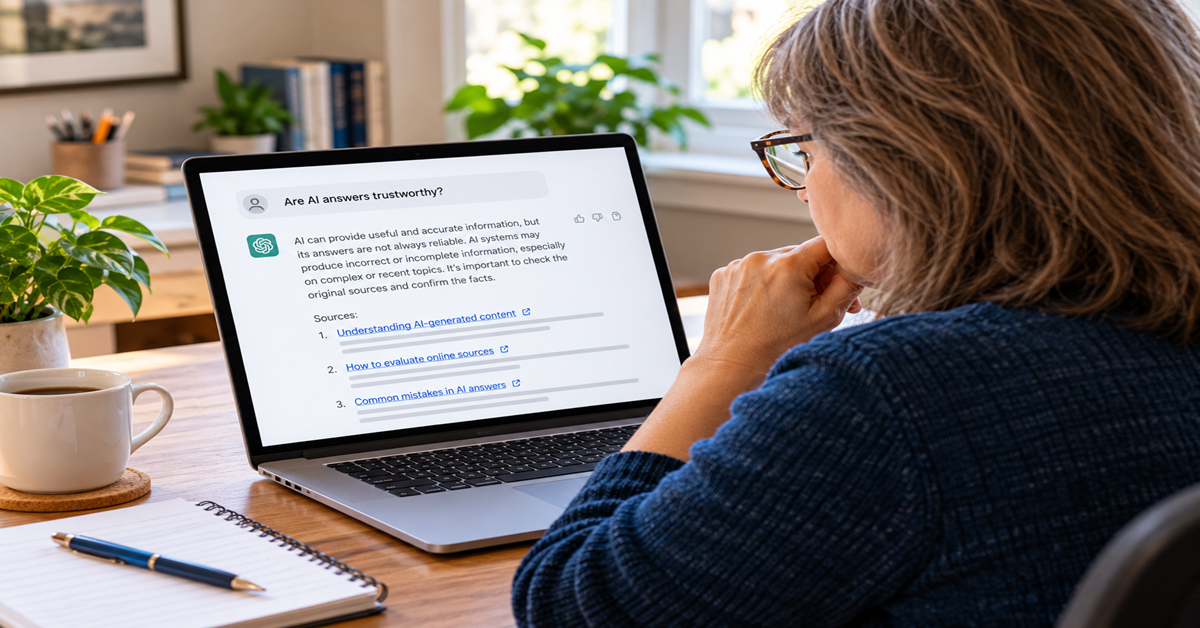
Are AI’s answers worth trusting? AI can be a powerful tool. But how do you know whether its information is reliable?
As I was working on my latest article for Borlok Transcription, I appreciated the convincing answers that included citations. But I discovered that not everything was reliable. My research and verification of what AI told me took longer than writing the article.
This article explores why AI’s answers may not be as valuable as you might think. Just because AI provides information that sounds credible doesn’t make it true.
What Makes a Source Credible?
Before we can answer the question “What makes a source credible?” we need to understand what we mean by credible.
Merriam-Webster gives us two definitions:
- offering reasonable grounds for being believed or trusted
- good enough to be effective
A good synonym this dictionary suggests is “plausible.” Does it sound convincing?
I remember being late for dinner one night as a child. My excuse was credible. I was in the barn watching my pony foal. In this case, my excuse was believable and true.
However, that is not always the case. Just because something sounds believable doesn’t mean it is.
For example, suppose you’re researching software for your business. A customer writes a glowing review about how well the software works. That customer may be telling the truth about their experience, but does that mean the software will work equally well for everyone?
Maybe not.
Now suppose AI uses that review to recommend the software as the best available. The review may be genuine, but does it provide enough evidence to support that recommendation?
It depends on what information you’re seeking, who’s providing it, and whether that person or organization has the knowledge or evidence to support it.
That is why a source can be credible for one purpose without necessarily being authoritative for another.
Can AI Sound Right Even When It Isn’t?
AI is not always correct with its answers. Sometimes its conclusions go beyond what the available evidence supports. I found that out the hard way. When I was doing research for a recent article, I asked AI Mode this question:
“Please answer this question: Are new jobs opening up in audio transcription, scoping, or proofreading as a result of AI doing the initial draft work? When you answer, please include the sources you got your answer from.”
I really liked the answer, but something made me stop and question its findings. Here’s what it gave me:
“Yes, new specialized job titles are opening up as a direct result of AI doing initial draft work, but the nature of the industry is fundamentally shifting. Rather than hiring workers to type or format documents from scratch, companies are increasingly looking for “AI Transcription Editors,” “Transcription Reviewers,” and “AI Trainers.”
But when I looked at the sources it gave me, one took me to a job board, another discussed stenography, and the third assessed how AI might affect scoping jobs.
Here is my point. AI gave me an answer that sounded convincing and included sources. But when I checked those sources, I couldn’t establish that they supported its conclusions.
Just because AI gives you an answer with citations doesn’t mean those citations support what it’s telling you. You still need to check.
Citations Aren’t Proof
Artificial Intelligence (AI) can be a writer’s best friend. It can help you find information much faster than researching everything yourself. But just because AI provides a citation doesn’t mean the information is accurate.
Citations give credit to the original source and help readers see where information came from. However, citing a source and verifying that the information you’re sharing is accurate are two different things.
Just because AI gives you a reference doesn’t mean you should automatically accept it. You should always go to the source and read the pertinent information yourself. There are several reasons why:
- The link may be broken.
- The information may be a copy of a copy of a copy, rather than coming from the original source.
- AI may have misinterpreted the information.
- The source may not support the conclusion AI gives you.
Before using an AI-generated citation, make sure the source supports the information you’re sharing. Being less than careful can damage your credibility and reputation. You could also lose the trust you’ve worked hard to build with your readers.
Does Finding the Same Information on Multiple Websites Make It True?
Finding the same information on several websites doesn’t make that information true. It can even be confusing. You can find “copycat” information on dozens of websites. So, how do you find out which source was the original?
Let me give you an example.
Say you are writing an article on semantic clarity and want to know more about it. So you type what is semantic clarity into your search engine. Surprise! There are quite a few websites that address this very question in almost identical words. That may not be coincidental. But how do you know which site is the original source, and why is it important?
This is where you become a detective to untangle whether the information AI is giving you is worth trusting.
Finding the same information on multiple websites can make you think it must be true. After all, if so many websites are saying the same thing, they can’t all be wrong, can they?
Don’t fall into that trap.
Seeing the same information repeatedly doesn’t make it true. You still need to take the extra steps to verify it.
There’s another problem called circular reporting. This happens when websites keep repeating the same information, either word for word or paraphrased, without independently verifying it. It’s like being on a never-ending hamster wheel. The information keeps going around and around, and the original source gets buried.
Let me show you how this can happen.
- Website A publishes a piece of information that hasn’t been properly verified.
- Website B finds the information on Website A and publishes it on its own site.
- Website C is researching the same subject, finds the information on Website B, and publishes its own version.
- Meanwhile, some time has passed, and Website A is updating its original article. It discovers Website C’s information, likes what it reads, and uses it to support its original claim.
See what happened?
Website A is now using information that originally came from its own website to support what it published in the first place.
And because the same information appears on several websites, readers may assume it’s been independently verified when it hasn’t.
How Do You Find and Verify the Original Source?
As you’ve seen from what we’ve discussed so far, finding sources can be tricky. It can feel like you’re searching for a needle in a haystack. But take heart. There are ways to discover them. Let’s look at a couple:
- Follow the citations. Look for links to the original research, reports, or statements. Follow those links rather than accepting another writer’s interpretation.
- Search for exact wording. Put a distinctive phrase in quotation marks in your browser search bar to see where else it appears. Compare the sources and look for clues about where the information originated.
Finding the original source isn’t just about giving proper credit; it’s about protecting your writing’s accuracy.
AI can give you a convincing starting point, but your research helps determine whether you have enough evidence to publish it.
Does One Person’s Experience Prove a Point?
While researching my Borlok Transcription article, AI listed sources like Reddit or Facebook. Let me ask you a question.
Do you think one person’s social media experience means everyone will have the same experience?
Here’s a hint.
Just because one person had a positive experience doesn’t mean everyone will have the same one.
Similarly, personal experiences, opinions, and discussions aren’t always appropriate evidence for AI’s claims.
For example, someone on Reddit might say a particular transcription program didn’t work well for them. AI could use that experience to support a broader claim that the program is unreliable.
The person’s experience may be genuine. It’s the broader conclusion that isn’t necessarily justified.
To determine credibility, we would need to think about three things:
- Who is providing the information? Can you establish their identity, qualifications, or firsthand experience?
- What kind of information are they sharing? Is it an opinion, personal experience, professional observation, or factual claim?
- Can you verify what they’re saying? Is there independent evidence supporting their statement?
Not every personal experience can be independently verified. That doesn’t automatically mean we can’t use it. It simply limits what conclusions we can reasonably draw from it.
What Happens When AI Search Decides What’s Trustworthy?
AI search can provide sources, but clicking one doesn’t prove the information is accurate or supports a claim. There is a difference between visibility and credibility.
The University of Maryland, in its University Libraries Research Guides, published “Artificial Intelligence (AI) and Information Literacy: What does AI get wrong?” I ran across this article while researching AI for this section.
It was interesting because it explains some of the issues I frequently experience while using AI to search for articles. I wasn’t able to follow its examples all the way through, but the explanations are clear and do give food for thought.
It’s not always easy to determine whether the sources AI cites are credible. Looking back through my research notes for the transcription article, I found two reminders I’d written to myself.
- AI can give you a legitimate source, but when you go to verify it, you may discover that it doesn’t support what you need for your article. The references the author provided didn’t support what I needed to establish. They were either out of print, outdated versions, or didn’t apply to what I was writing about.
- In another note, I had written, “Sources are freelance websites. Verify claims are valid.” I remember that one of the sources claimed to be “the most comprehensive scoping school program available.” What I needed to check was whether other sources backed up its claim. I couldn’t rely on that claim without verifying it.
When we use information from AI search without verifying it, we risk losing our readers’ or clients’ trust. AI search can save us time, but that doesn’t mean we should use everything it finds.
Are AI’s Answers Worth Trusting?
Not always.
Just because information sounds convincing doesn’t mean it’s accurate. It depends on why you need the information, who’s providing it, and the context in which you’re using it.
AI can save writers considerable research time, but it can also misinterpret information and provide citations that don’t support its claims.
The bottom line is that AI can be a useful research tool, but we still have a responsibility to verify what it tells us. That means checking the original sources, examining the evidence, and making sure the information supports what we’re writing.
AI can help us find the information. Our responsibility is to determine whether we can trust it.
📅 Published on October 26, 2026
Pam Lokker is the founder of Borlok Virtual Assistants, LLC, where she helps businesses and creators improve visibility through clear, structured, and SEO-driven content. She specializes in semantic clarity, AI visibility, and content strategy for today’s evolving search landscape.
See how a website visibility & content audit can help you.
She is also the creator of Pam’s Insightful Pen, AI Content Visionary, and Design Visibility Insights, where she shares practical insights for digital writers and business owners.
